
Book Review: Principles for Dealing with The Changing World Order
Updated: Feb 7
By Alexander Anchor
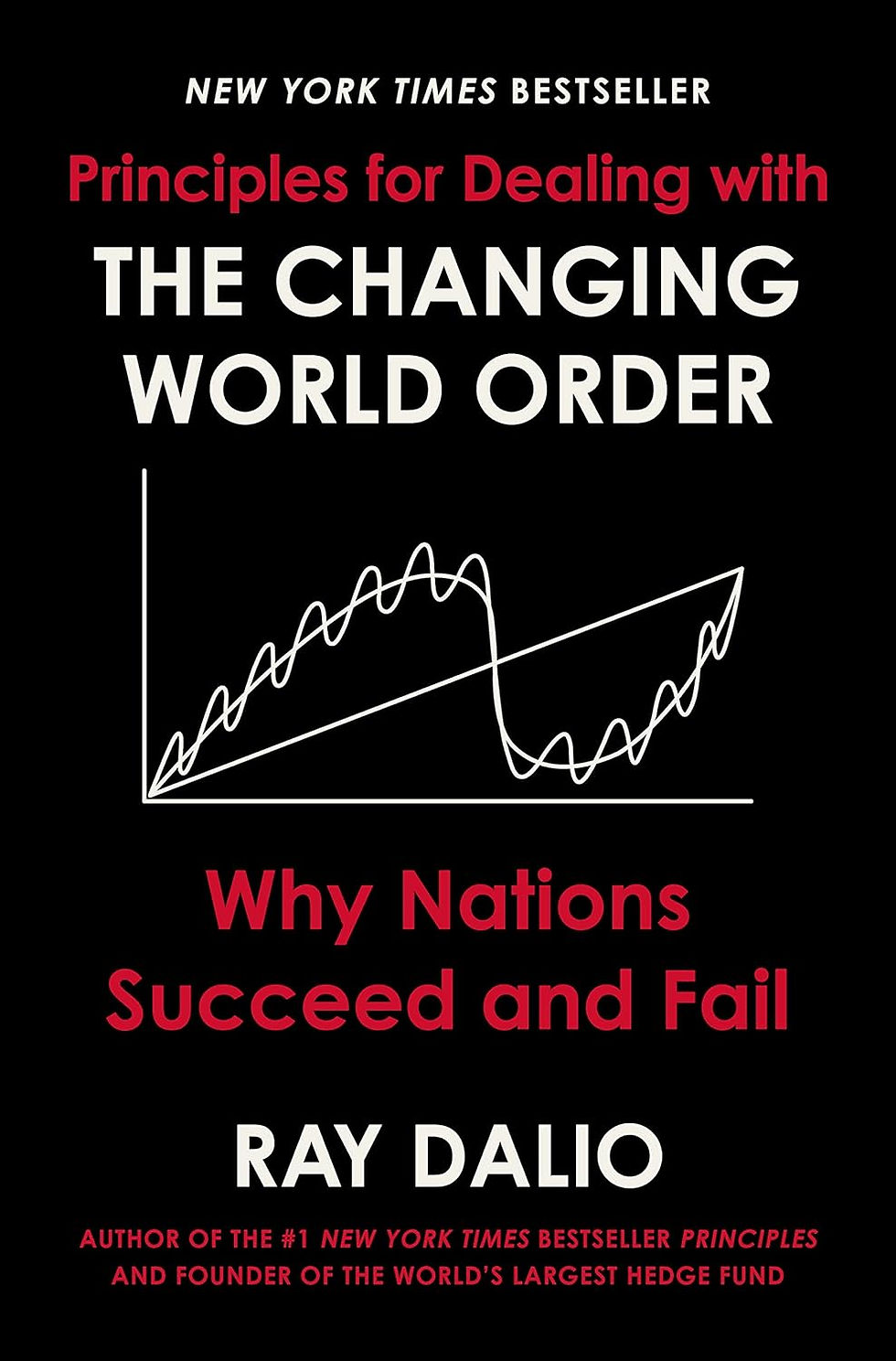
Founder of the world’s most successful hedge fund, Bridgewater Associates, Raymond Dalio proves himself in his book: Principles for Dealing with the Changing World Order – Why Nations Succeed and Fail, more than just a cluey investor, but a historian of international relations, ready to share why superpowers fall and how others rise. By exploring the rise and fall of great powers over the past 500 years, Dalio leaves readers wondering what the post-US-led world order will look like and whether the United States can defy five centuries of precedent.
If I had to summarise Dalio’s book, I would share the following aphorism that seems to encapsulate the book’s key concept: The Big Cycle. The saying goes that, “Hard times create strong men, strong men create good times, good times create weak men, and weak men create hard times”.
According to him, history has progressed linearly and predictably for the past 500 years. Following a period of great disorder, typically a conflict between a rising and a ruling power, the victorious side establishes a new world order. The good times or “the rise” then follow for the winners. At the peak of their power, however, the frugal and determined attitudes of the strong men who created the good times dissipate. Decadence sets in, and the country’s decline begins, ushering in hard times. This is The Big Cycle. Not all countries are at the same point in their cycle; however, this makes a superpower’s decline a prime opportunity for a rival power at the start of its rise to replace it.
Dalio largely substantiates these claims in the second section of his book. Across three chapters, he traces how the Dutch Empire defeated the Spanish in the Eight Years’ War and succeeded it as the pre-eminent power; how the British replaced the Dutch following the Fourth Anglo-Dutch War; and finally, how Britain, devastated by two world wars with a rising Germany, was replaced by the United States. Naturally, Dalio spends extensive time discussing China’s rise and fall throughout history and its latest comeback.
More than just a recount on the rise and fall of empires, however, Dalio goes into great detail in the first section of his book discussing the “determinants” that contribute to a country’s rise. For him, the most important are education, innovation, trade dominance, reserve currency status, strong civility and strong leadership. These are the relevant metrics for measuring a country’s rise and decline. The Dutch, for instance, were highly educated and hardworking. At their peak, they produced a quarter of the world’s inventions and dominated world trade despite only having a population of 2 million. This, alongside a formidable navy, firmly placed them as the world’s hegemon. Predictably, decadence set in. Overspending led to a debt-financed economy that eventually collapsed. This allowed for a rival rising power, Great Britain, to take its place.
Today, the United States is suffering from the symptoms of its superpower status. Like the Dutch and British Empires before it, its reserve currency status has allowed it to borrow and accumulate massive debt. Similar to the offshoring of the Dutch shipbuilding industry in the 1600s, high wages have contributed to the offshoring of American manufacturing. Like the British Royal Navy between the 17th and 20th centuries, the United States’ military has overreached and continues to cost hundreds of billions of dollars. China, on the other hand, has all the hallmarks of a rising superpower. In 2013, it overtook the US as the world’s largest trading partner. It is currently leading the world in innovation. The Chinese typically save rather than spend or borrow. And its military has continued to grow larger and more modern.
Dalio should be commended for authoring such a simple yet effective book. His use of everyday language and short sentences makes it an accessible read. His ability to explain crucial moments in history succinctly and link their overall relevance to the discussion is also extremely valuable. He urges his readers to keep these historical events in mind and look for their contemporary counterparts.
Dalio does spend a noticeable amount of time in the first section of his book discussing economic principles and the “determinants” that contribute to a country's rise. These chapters may therefore be less interesting to aspiring young diplomats. However, Dalio bolds certain sections of his text, so there is the option to read a short version of each section of the book. Readers interested in international relations, including the rise and fall of superpowers, can always skip to the second section.
Dalio succeeds in educating his readers on the past so that they can see examples of it in the present. Students of international relations will walk away from this book wondering what post-Pax American will look like and if the United States can defy 500 years of history and retain its superpower status. Likewise, policymakers should pay close attention to the determinants that Dalio identifies as crucial to a country’s overall prosperity.


As a PhD student juggling research with a part-time job at Affordable Assignments where I provide Assignment help UK and assist fellow learners with their academic work, I found myself deeply drawn into the themes in the “Book Review: Principles for Dealing with The Changing World Order” on this site it speaks to the very cycles of challenge and opportunity I’ve seen in both global history and in my own academic journey. Just as Dalio’s concept of the “Big Cycle” shows how nations rise through strength, innovation, and resilience and later face decline when complacency sets in, I’ve seen in my college days how hard work and commitment can feel overwhelming yet ultimately shape who you become, which is why helping other…