
Takaichi’s Mandate: Fighting to Save Face
By Lucas Ross
Introduction
In an election result that could redefine Asia’s strategic trajectory, Japan’s political landscape is entering a decisive new phase.
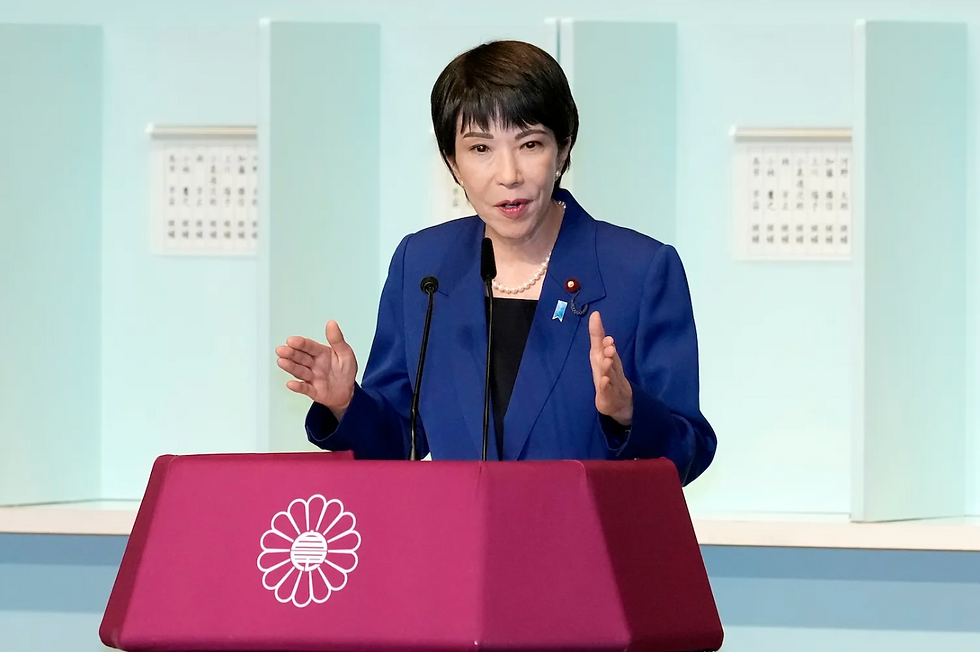
The re-election of Prime Minister Sanae Takaichi on the 18th of February 2026 has reinforced the dominance of the Liberal Democratic Party, signalling a continued rightward shift in the country’s economic and security posture. Her coalition consolidated a supermajority over the National Diet on February 8th which has provided a legislative mandate to advance defence expansion, industrial policy, and a reconsideration of Japan’s constitutional pacifism.
This political consensus suggests a long-term recalibration of Japan’s post-war strategic posture with implications for regional security and global economic governance reminiscent of policy trends in the 1940s.
Domestic Dilemmas
This political moment is particularly significant because of Japan’s hitherto remarkable institutional continuity since the end of the Second World War.
Anchored by Article 9 of the Japanese Constitution, Japan’s post-war political economy was built on a dual compromise: economic expansion under export-led growth and security dependence on the United States. However, under Prime Minister Sanae Takaichi, the state is reasserting a more interventionist role in defence and industrial policy. This signals a departure from a restrained strategic posture back towards a more classically hardline approach reminiscent of Imperial Japan. However, a question remains, is Takaichi’s approach to policy appropriate for Japan’s current domestic climate?
Recent economic indicators suggest a stagnating domestic economic environment that contradicts the long-term viability of Takaichi’s public policy. Japan’s economic growth remains weak, with real GDP growth at 0.6%, highlighting the persistence of long-term stagnation. Simultaneously, Japan carries an extraordinary fiscal burden, with government debt exceeding 226.8% of GDP, constraining the state’s long-term financial flexibility. If Takaichi’s goal is to increase government spending amidst the trilemma of a budget deficit, weak GDP growth, and crippling national debt, we must ask how she intends to fund her policy objectives.
Furthermore, inflation stands at 2.1% while interest rates remain low at 0.75%, indicating limited monetary policy options to stimulate further demand, placing emphasis on the necessity of efficient spending. However, the unacknowledged capstone problems of population shrinkage, high elderly dependency ratio, and increasing youth suicide places strain on the efficacy of Takaichi’s policies.
Collectively, these indicators help to clarify the neglected sociological root of Japan’s domestic dilemmas. As population aging and social dislocation intensify, they exacerbate labour shortages, dampen productivity, and undermine the effectiveness of traditionalistic fiscal policy. A pattern that has persisted throughout Japan’s modern and late-imperial history.
With this clarification, the Takaichi administration’s emphasis on industrial policy, defence expansion, and economic security can be interpreted as a Keynesian attempt to offset stagnation through government spending and supply side macroeconomics. Despite the apparent economic logic to this approach, such policies will ultimately exacerbate Japan’s substantial fiscal liabilities whilst continuing to neglect Japan’s multifaceted sociological crisis that has remained central to their domestic dilemmas for decades.
Beyond fiscal considerations, the political implications of this strategy are perhaps more significant. Industrial policy and defence expansion carries important political symbolism within Japanese society. For decades, Japan’s strategic identity has been closely tied to constitutional pacifism and the memory of wartime devastation. Any attempt to reinterpret or revise these constraints inevitably provokes intense public debate regarding the country’s historical responsibilities and regional role. Consequently, the current administration’s policy agenda and the new construction of long-range missiles across the East China sea reflect upon a deeper debate of national identity and historical memory, a debate with significant international dimensions.
In the Shadow of Empires
On an international scale, the election of a populist supermajority in Japan is consistent with international trends. In Destined for War, Graham Allison describes the Thucydides trap as the emerging structural stress that arises when a burgeoning power challenges the position of the current hegemon. While the concept remains contentious, it provides a useful lens through which to view Japan’s political posture amid intensifying strategic competition between China and the United States.
The Thucydides trap allows us to understand Japan’s actions as a natural consequence of shifting global power structures. However, this proves a precarious prognosis as the two main outcomes of this logic are either global hegemonic bifurcation or a temporary balance of power resting on the emergent tension of bellicose militarism across Asia and the Indo-pacific.Through this line of reasoning, commentators such as Jake Thrupp optimistically presume the latter. Thrupp believes that “Takaichi’s victory is a win for the Indo-Pacific,” reinforcing maritime deterrence and the preservation of a rules-based regional order.
This perception of Takaichi’s victory has many critics, as Japan’s contemporary strategic posture cannot be understood solely through hegemonic rivalries on the other side of the world. During the period of the Qing dynasty from 1644 to 1796 the regional order was fundamentally organised through a loosely upheld tributary system, a diplomatic structure in which neighbouring states acknowledged Chinese cultural primacy while retaining varying degrees of autonomy as vassals. As David Shambaugh notes, Chinese imperial relations rested on the principle that “all surrounding countries were in principle subservient to the empire and that their representatives ought to show up in the imperial capital at regular intervals to proclaim this deference.”
While many East Asian polities participated in this hierarchic system, Japan maintained a far more ambivalent relationship with it. During the rule of the Qing dynasty and earlier imperial periods, Japanese elites frequently resisted full incorporation into the diplomatic order, preferring to maximise political autonomy even while engaging in limited tributary exchanges. Subsequently, Imperial Chinese elites often viewed Japan as lying beyond the sphere of civil society, regarding the Japanese as piratical troublemakers beyond the immediate realm of civilization.
The current strategic competition is layered with centuries of complex and often contested bilateral relations. This historical context is crucial for understanding why Japan’s contemporary policy choices should be perceived not just as a product of hegemonic friction, but as a reclamation of past strategic identities and dignities. This perception is deeply intertwined with the resurgence of a global economic paradigm shift.
A Neo-Mercantilist Renaissance
Globally, Japan’s policy direction reflects a broader trend among advanced economies toward a revival of neo-mercantilist policy paradigms. Neo-mercantilism broadly refers to a state-centric economic strategy in which governments actively intervene in markets through industrial policy, export promotion, trade restrictions, and strategic subsidies.The aim of this strategy is to strengthen national power and competitiveness. The consequences of this shift are already visible in the intensification of export controls on advanced semiconductors and the expansion of defence-industrial subsidies.
This neo-mercantilist revival has seen mounting support over the past decade as confidence in the post-Cold War liberal international order has weakened in the face of China’s unprecedented ascent to power. China’s ascent could not have been achieved without the use of liberal institutions such as the Bretton Woods system, the WTO, and the IMF. The solution reached by the western world, to combat this rise, is to undermine the current paradigm with the inherently illiberal stance of neo-mercantilism. Yet, as Cooley and Nexon observe, dismantling or weakening the institutional networks that historically amplified Western influence will ultimately erode the very infrastructure of alliances, markets, and financial coordination that sustained that influence in the first place.
This dynamic reflects a deeper structural shift within the international political economy. For much of the late twentieth century, globalisation was characterised by the assumption that economic interdependence would reduce geopolitical tensions and encourage institutional cooperation. Currently, that assumption is increasingly questioned as states recognise that economic integration can also generate strategic vulnerabilities. As Eric Helleiner observes, many neo-mercantilist thinkers viewed international politics as a “struggle for survival between states which required the aggressive projection of power abroad.”
As a result of this logic, economic policy has become increasingly securitised. States are instead investing heavily in domestic manufacturing capacity, imposing restrictions on technology exports, and pursuing strategic industrial subsidies. This shift is being justified by the need to overcome the advantages that powerful foreign firms derived from their established market positions.
Japan’s evolving policy framework is therefore representative of the broader transformation of globalisation itself. Rather than operating within a universally integrated economic order, states are gradually constructing parallel systems of production, technology, and finance aligned with their respective strategic blocs.
Conclusion
Japan’s trajectory is now set. Japan under Takaichi is no longer a reactive power content to hide behind Article 9 and American guarantees. It is reaching outward militarily, economically and strategically, into a region already buckling under the weight of great-power rivalry. Yet for all the missiles and industrial subsidies, the most significant battlefield for Japan may be domestic. A greying population, a debt-to-GDP ratio that would crush lesser economies, and a society quietly unraveling from within are vulnerabilities with no simple legislative solution. Takaichi's mandate represents a profound paradox. A government eager for external confrontation with a long-time imperial rival, while its internal foundations erode. Chinese primacy is not the greatest threat Japan faces. The far more immediate danger is that a nation so focused on saving face abroad may fail to see the cliff edge directly ahead of it.
Lucas Ross is a second-year student in the Bachelor of Advanced Political Science and International Relations (Honours) at Griffith University, specialising in security, conflict, and human rights. A recipient of the Griffith Award for Academic Excellence, his research focuses on political theory, institutional analysis, and global governance.


Comments