
If You’re Here, You Need to Know Who Mindy Seu Is
By Nyx Joy
On Mindy Seu, the Cyberfeminism Index, and what it means to pay the people you quote
Mindy Seu counts things. In her own informal biography, she notes that one year she gave eighty-nine lectures in eighteen countries, taught forty-nine design students and twelve art students, bought three couches and sold two, drank zero cups of caffeinated coffee, and lost countless games of chess. When asked how many other professors are pioneers of cybertechnology, a Jacquemeus model, and rewriting how we think about digital museums and their parallels to academia, Mindy instead mentions how students are intimidated by her classes. But fret not, amidst all her savvy, she is someone the youth can look up to and, moreover, understand.
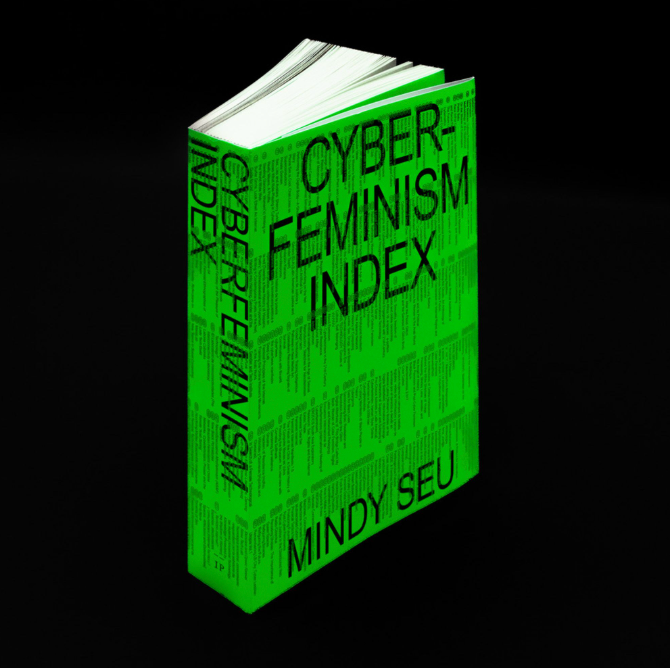
In March 2019, Seu tweeted “I'm creating a cyberfeminist index” and shared a link to a spreadsheet she hoped would become a site of collaboration. As that spreadsheet grew to nearly seven hundred rows, at a time when info-activism and open-access libraries proved crucial to consciousness-raising across global exigencies, Seu used the data to create cyberfeminismindex.com. By January 2023, that living document had been repackaged as a 600-page book with a foreword by Julianne Pierce from VNS Matrix, the Australian art collective that coined the term cyberfeminism in 1991, and an afterword by Legacy Russell, (author of Glitch Feminism: A Manifesto). The book's cover glows neon green, the same shade as the 'submit' button on the website which invites collaborative editing and compilation, and has become a precedent for academics in conceptualising sources for cyberfeminism in an ever-growing sphere of online libraries.
Cyberfeminism, to anyone encountering the term for the first time, deserves a whole class in itself. Cultural theorist Sadie Plant developed the concept throughout the early 1990s and formalised it in Zeros + Ones: Digital Women and the New Technoculture. She argued that women had been central to computing's development for generations through weaving and typing, computing and telecommunicating, and tending the machinery of the digital age. The early cyberfeminist premise was that the internet might offer space in which the structures of patriarchal offline life could, at least partially, be rerouted.
What happened instead, as Legacy Russell documents in Glitch Feminism: A Manifesto, was that the movement reproduced many of the exclusions it meant to dissolve. Its public intellectual face remained overwhelmingly white, overwhelmingly rooted in Western art school culture, and the digital frontier was theorised as though marginalised bodies did not already inhabit it. Artist Tabita Rezaire named this condition “electronic colonialism” in her 2014 video work Afro Cyber Resistance, arguing that the internet's geographical biases were structural rather than incidental. Julia R. DeCook's essay, which closes Seu's Cyberfeminism Index, calls for a critical reassessment of cyberfeminism's founding text, arguing that theorists must find ways to think without upholding whiteness and Western epistemology as the center. That the field placed its self-critique at the back of its own archive is both an act of honesty and of irony.
Seu’s Index is organised across five sections: reading lists, annotated entries, source titles, prominent figures, and images. Among the Index’s intellectual ancestors, per Seu's Dialectic interview with Leslie Atzmon and Laura Coombs, is the New Woman's Survival Catalog (1973) by Susan Rennie and Kirsten Grimstead, billed as the feminist counterpart to the Whole Earth Catalog. Seu draws from the rhizomatic model of the New Woman's Survival Catalog and through naming other cyberfeminists, traces the topic at hand across generations.
Through Seu’s second book, A Sexual History of the Internet, she announced a payment model she designed with the conceptual groundwork laid in “Multidimensional Citation.” In that essay, which Seu co-wrote with Laura Coombs and Laurel Schwulst for Serving Library in 2022, they interrogated how citation functions simultaneously as an intellectual and economic act. By the time she was designing A Sexual History of the Internet, that inquiry had become a new way to pay scholars what they're worth. This significantly comes at a time when critical thinking is no longer easy as every piece of information is increasingly received as public property.
A common payment model for publishing looks like this: a publisher takes a majority cut of book profits for production, storage, and shipping, while the author receives approximately ten percent and other members of the team receive fixed lump sums. For A Sexual History of the Internet, Seu worked with Yancey Strickler of Metalabel, an artist publishing platform built around transparent profit distribution, to design what she named “Citational Splits,” a pool in which those cited would equally split thirty percent of profits in perpetuity, including all future reprints. Not only did she want to cite everyone, she wanted to develop a new model of citation saying let's credit everyone, let's pay everyone. Of the forty-six people cited within A Sexual History of the Internet and invited to participate in the Citational Splits model, twenty-seven opted in to receive a share of the profits, each earning approximately $0.19 per book sold (approximately $850). What the model encountered in practice, though, is that redistribution does not exist outside the systems it is trying to redistribute within. One participant who initially agreed to join the Citational Splits pool later chose to reallocate their share to the other participants because they were unable to access Metalabel's payment processor, Stripe, which commonly and unethically bans sex workers from its platforms. Seu disclosed this in her published breakdown of the project's finances. The point, nevertheless, is not arithmetic. It is a theme across academia that citation has always been currency: it confers legitimacy, shapes careers, determines whose work gets read by the people who assign the next round of grants.
For readers at Young Diplomats Society whose work intersects with questions of knowledge sovereignty, intellectual property across borders, and the political economy of expertise within international institutions, Seu's Citational Splits model offers an artist-led proof of concept for redistribution built at the scale of what an individual can actually implement. It is a concept in direct contrast with existing micropayment models focused on automation and scale, one in which intentional opt-in means choosing where money goes rather than allowing an algorithmic proxy to choose for us. A book of five thousand copies will not reform how academic publishing credits the communities whose knowledge it draws from. Proof of concept is, though, what political imagination looks like and Seu's eighty-nine performative readings across eighteen countries, her spreadsheets, her counted couches, suggest someone who understands that ideas require logistics to survive. In her introduction to the Cyberfeminism Index, Seu insists that the project is, like its web-based predecessors, open to revision and collaboration. The bibliography is still accumulating and thus someone, right now, is adding a row.


Comments